Thursday, October 26, 2023

Photomicrograph: Mineral Filled Vesicle

I came across this stunning image of a mineral filled vesicle on the September 2023 cover of Geology. The rock sample was collected from the Louisville Seamount Chain in SW Pacific Ocean.

 Source: Elmar Albers et.al. 2023- Timing of carbon uptake by oceanic crust determined by rock reactivity.

Vesicles in igneous rocks are spherical holes formed by expanding gas bubbles. As lava erupts, dissolved gases bubble out. Lava solidifies fairly rapidly on exposure either to air or water. The bubble shape is retained as a small cavity. It gets filled with minerals when magmatic fluids and mineral saturated seawater or groundwater circulate and react with the rock. 

The basalt rock in this study is about 50-74 million years old. The calcite in the vesicle precipitated within 8 million years of eruption. Alteration of undersea basalt is a CO2 sink. Basalt reacts with seawater, trapping carbon in carbonate minerals. The calcium required for formation of carbonate minerals is provided by the alteration of minerals like plagioclase. The study is trying to estimate how long such carbonation reactions continue. Carbonated oceanic crust eventually sinks into the mantle at subduction zones sequestering carbon from the surface for hundreds of millions of years.

This particular vesicle is filled with carbonate (calcite) and clay. Notice the beautiful banding suggestive of pulses of mineral formation. Among the brown and white layers are white bands of faceted saw tooth calcite. And the upper part of the vesicle is filled with large irregular shaped crystals. Surrounding the vesicle is the 'groundmass', made up of tiny crystals of plagioclase feldspar, iron oxide, and volcanic glass. There is no scale in the picture, but my guess is that the vesicle is a few hundred microns across.

In a hand sample a vesicular basalt will look like the example below. This is from the Deccan Traps near Pune. 
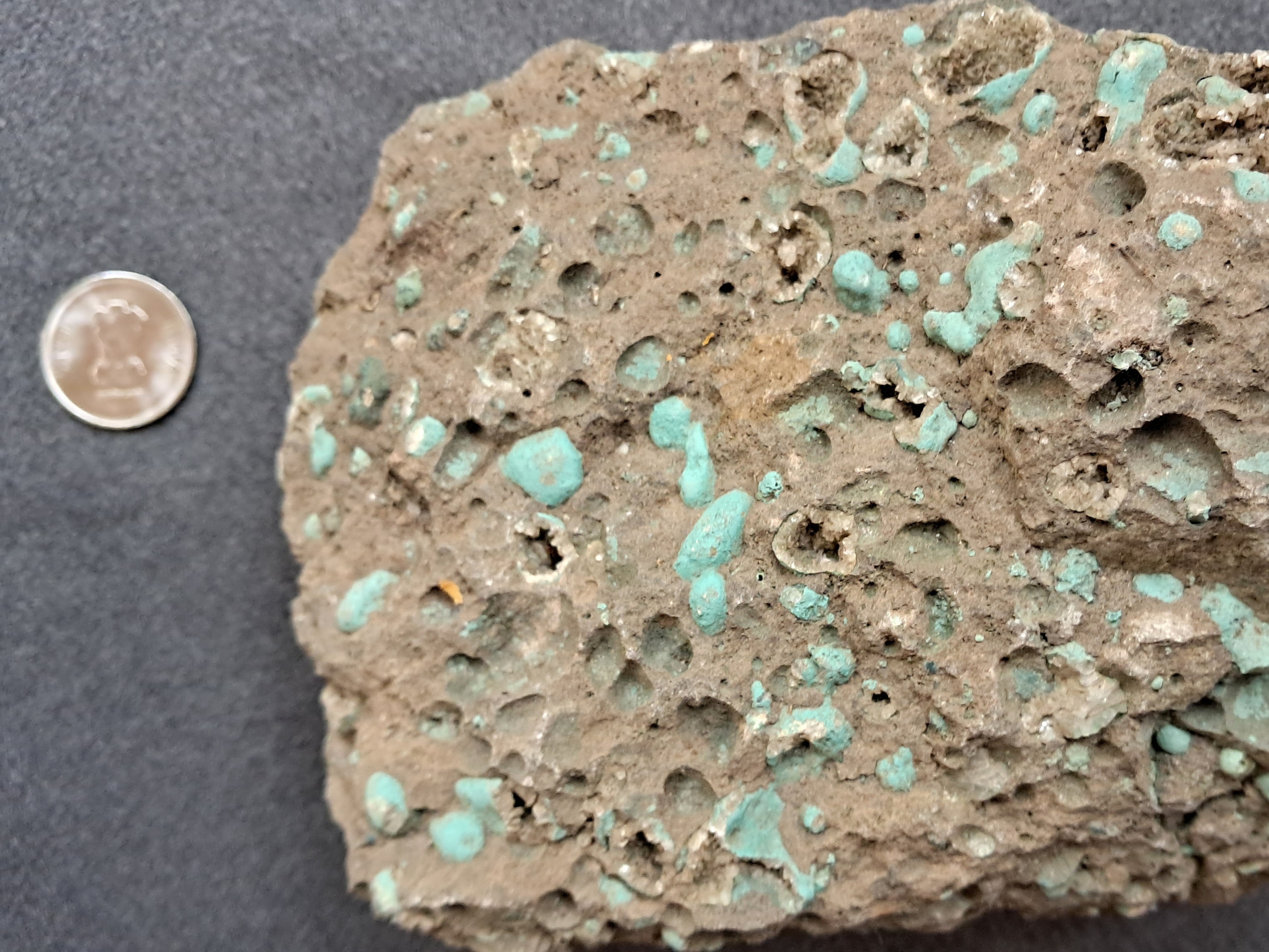
The vesicles here are much larger than the first example. Many are empty. Some vesicles have a lining of tiny crystals. Carbonation of terrestrial basalts also constitutes a carbon sink.  Combating global warming and achieving net zero emissions will require, foremost, a steep reduction in emissions, but additionally also removing carbon dioxide from the atmosphere and safely storing it in long term reservoirs. Such carbon removal and sequestration projects are exploring the potential of basalts and related igneous rocks as a long term carbon sink. 


Thursday, October 19, 2023

Links: Volcanic Underworld, First Americans, Billion Year Old 3D Microfossils

Readings over the past few weeks.

1) Taking the First Steps Into a Newly Formed Volcanic Underworld: Maya Wei- Haas describes a fascinating landscape on the Canary Islands in the Atlantic Ocean. Volcanic eruptions and the transport of lava via underground tubes has formed a subterranean world of stacked lava tunnels and caves. Their mapping is ongoing and scientists hope to understand not just the details of volcanism and the hazards it poses, but also how life can colonize such nascent surfaces, powered by nutrients from minerals. As one of the scientists remarks- "lava tubes is a rare chance to watch an evolving ecosystem from time zero".

2) It looks like the 23ky old human footprints at White Sands are solid: What is the earliest securely dated evidence of people in the America's? In 2021, there was a report of human footprints from an ancient lake in New Mexico. Since the footprints themselves could not be dated, seeds of an aquatic plant that were found in the same layer were carbon dated to about 23 thousand  years ago. That result was greeted with caution. The main concern was that the seeds may have taken up much older lake water containing less of the radioactive isotope C14. This may have made the dated material look older than it actually was. 

Now, there has been more work on the geochronology of the site using two more independent lines of dating. The results agree with the previously estimated date of 23 thousand  years. ArcheoThoughts summarizes the dating methodologies. 

3) Discovery of oldest 3D-preserved microorganisms: Before organisms evolved the ability to build hard skeletons, their remains have been preserved as impressions on soft sediment or as chemical degradation products recognizable by a light carbon isotope signal. Stefanie Terp reports on a discovery of 3D preservation of microorganisms from a mine in Ukraine. They are 1.5 billion years old! 

Scanning Electron Microscopy reveals the filamentous structure of these creatures. They are most likely a variety of fungi. Groundwater in the granite environment in which they lived was saturated with aluminum and silica. The microorganisms were covered and entombed in micrometer thin layers of aluminum silicate, perfectly preserving their delicate structure.

Saturday, September 30, 2023

Iron Pisolites From Western Ghats

A reader sent me this photograph of a pebble he had collected from a stream bed near Belgaum, Karnataka.

 Photo credit: Gopisundar

These look to me like iron rich pisolites. These spheroidal grains form by the accretion of iron, manganese, and aluminum hydroxides around a nucleus. The core may be an aggregate of soil particles, a rock fragment, or even wood debris. 

You will notice that the core is quite massive and structureless but in a few grains a crude concentric layering is seen at the margins. The pisolites are bound together into a firm mass by mixture of clay and iron aluminum hydroxide. Pisolites form during prolonged episodes of chemical weathering of  rocks like basalt or shale or iron aluminum rich metamorphic rocks. They are present in thick laterite and bauxite profiles. 

The picture below is a representative example of pisolite from a location in Brazil. It shows the occurrence of pisolite layers in a weathered soil profile, along with a hand sample and a cross section under high magnification.


Source: K Marques et.al. 2022: Geochronology (preprint).

Here is a map of the landscape just south of Belgaum that I am describing in this post. 


 Source: Amanda Jean et.al 2020: Journal of Geological Society

It shows the distribution of three distinct horizons of chemically weathered soil, named as the S1, S2 and S3 surfaces. Each of these horizons consist of tens of meters of laterite or bauxite and manganese rich ore. There has been some recent success in dating these weathered layers using the mineral crytomelane, a potassium rich manganese oxide. Three distinct weathering periods are documented. As India broke away from Gondwanaland it eventually drifted northwards into tropical climatic belts. Throughout the Eocene to Miocene, long phases of hot humid climate resulted in intense chemical alteration of the Western Ghat landscape. 

The oldest soil, surface S1 in the map, formed between 53-44 million years ago. Surface S2 formed later in the Oligocene-Miocene between 39-22 million years ago. And surface S3 developed in the mid Miocene, between 14-10 million years ago. 

The graphic below tells a story of landscape evolution recorded in the formation of these three weathering profiles. 


 Source: Amanda Jean et.al 2020: Journal of Geological Society

Episodic dissection of a plateau through the Cenozoic kept stripping away rock layers, and younger bauxite and manganese rich soils formed at lower altitudes on freshly exposed rock and debris flows. The youngest surface S3 has developed on a pediment. These are layers of debris eroded from surrounding hills that accumulate in low lying areas. Surface S3 indicates a very active phase of weathering and erosion of the surrounding mountains ranges that took place between 22 and 14 million years ago. As a once contiguous plateau was fragmented, older surfaces S1 and S2 remain preserved on isolated mesas and table lands.

The pisolite my friend sent me could have broken off from one of these surfaces. Its hard to say which one. The overall light color suggests that it is aluminum rich, and may have been sourced from the bauxitic S1 or S2. But this is just a guess. 

Pebbles from a stream can hold many secrets. Don't just chuck them away :)

Monday, September 11, 2023

Agglutinated Foraminifera From The Deep Sea

No matter how many David Attenborough specials you may watch, nature always throws more surprises at you.

Foraminifera are protists that build a skeleton or a test made up of calcium carbonate. The calcium carbonate is precipitated out of sea water. There is a sub-group of foraminifera which construct a shell not by capturing the calcium carbonate via chemical precipitation, but by assembling sedimentary grains and then cementing them together like a brick and mortar structure. This group of forams are known as agglutinated foraminifers. 

All this is well known. Many different species of forams use a variety of grains as bricks. They are mostly different shell fragments, but even mineral grains like ilmenite (iron titanium oxide) , rutile (titanium dioxide), or garnet are used. 

Now there is a new report of a deep sea living agglutinated foraminifera which constructs a tube made up of  planktonic foraminifera shell fragments of a single species

Read that again. A benthic (bottom living) foram shell made up of bits of another foram which lived floating in the upper water column!  

These shells are selected to the exclusion of all other types of available sedimentary grains. The specimens were recovered in a core drilled off shore northwest Australia by the International Ocean Discovery Program. The paper by Paul N. Pearson and IODP 363 Shipboard Scientific Party is published in the Journal of Micropalaeontology.

Here is the entire abstract. It is mind boggling. 

Agglutinated foraminifera are marine protists that show apparently complex behaviour in constructing their shells, involving selecting suitable sedimentary grains from their environment, manipulating them in three dimensions, and cementing them precisely into position. Here we illustrate a striking and previously undescribed example of complex organisation in fragments of a tube-like foraminifer (questionably assigned to Rhabdammina) from 1466 m water depth on the northwest Australian margin. The tube is constructed from well-cemented siliciclastic grains which form a matrix into which hundreds of planktonic foraminifer shells are regularly spaced in apparently helical bands. These shells are of a single species, Turborotalita clarkei, which has been selected to the exclusion of all other bioclasts. The majority of shells are set horizontally in the matrix with the umbilical side upward. This mode of construction, as is the case with other agglutinated tests, seems to require either an extraordinarily selective trial-and-error process at the site of cementation or an active sensory and decision-making system within the cell.


The photographs from the paper shows the tube of the agglutinated foraminifera made up of planktonic foraminifera shells of a single species.

Charles Darwin knew of agglutinated foraminifera from reports he had read and was astonished....“almost the most wonderful fact I ever heard of. One cannot believe that they have mental power enough to do so, and how any structure or kind of viscidity can lead to this result passes all understanding”.  This was a letter he wrote to W.B Carpenter who had described them in 1873.

I'll leave you to ponder upon this most exquisite of natural wonders. The paper is open access: A deep-sea agglutinated foraminifer tube constructed with planktonic foraminifer shells of a single species.

Monday, August 21, 2023

Darwin's Earthworms, Ocean Currents, Geology Heritage Lost

My latest set of readings.

1) Why Darwin Admired the Humble Earthworm. A delightful essay by Philip Ball on Darwin's work on earthworms. Published towards the end of his career, this book apparently sold more copies than the Origin of Species! As Philip Ball wittily observes, that tells us something about the English passion for gardening. Darwin's research on earthworms consisted of detailed observations and cleverly designed experiments, often carried out with the help of family members. 

His powers of observation and analysis remained undimmed - "Darwin reported that 80 percent of leaves he removed from worm burrows had been inserted tip first—a far from random distribution".

2) No, the Gulf Stream isn't going to shut down. The premise of the movie The Day After Tomorrow is that of a catastrophic cold snap engulfing north America and Europe, triggered by the shutting down of the Gulf Stream. This massive ocean current forms in the subtropics in the western side of the Atlantic and transports heat from the lower latitudes to northern Europe, moderating the temperatures in these northern regions. Media reports claim that recent work might be pointing to a collapse of the Gulf Stream, but as Frank Jacobs explains, people are conflating two very different current systems. 

Some studies are suggesting that the Atlantic Meridional Overturning Circulation, a much smaller and restricted circulation system, might be slowing down and might even collapse by 2050. This will result in some cooling in the Greenland and Norwegian seas, but will not affect the larger Gulf Stream. The article has a nice animation of global ocean currents which I found informative.

3) They Have Put Geology in Coffins. For long, geologists have been complaining about the utter indifference shown by successive Indian governments to our natural heritage. Here is one more example from Himachal Pradesh. Along the Kalka-Shimla highway, on the stretch between Parwanoo and Solan lay a treasure. This was a section of sedimentary rocks recording the retreat of the Tethys Sea which began after the collision between India and Asia started creating high topography. Along this stratigraphic section, marine sediments give way to freshwater deposits. The outcrop was a natural outdoor laboratory for students and researchers. Now it is gone. The National Highway Authorities of India has covered it with concrete and stone walls. Science is the big loser again. 

Arundeep Ahluwalia expresses the anguish of geologists who knew and loved this part of the Himalaya- "It forever denies coming generations any chance to study the long stretches of such highways and to the nature lovers in society the excitement of the history and grandeur of the earth".  

Read and weep.