Showing posts with label Ediacaran. Show all posts

Wednesday, July 16, 2025

Joshimath Landslide, Human Evolution, Early Animals

Sharing some of my readings over the past couple of weeks- 

1) Movement of Joshimath Landslide in India: The town of Joshimath in Gharwal Himalaya is built on an ancient landslide. Geological reports going as far back as the 1970’s had warned that excessive modification of the slope due to urbanization may result in slope movement and eventual failure. These warnings proved correct as slope movement since 2018 has caused major damage to houses and livelihoods. Landslide expert Dave Petley reports on a new study of the region that uses radar technology to track earth movements. 

It concludes that removal of vegetation, mismanaged groundwater seepage and blocked drainage paths contributed to accelerated movements of the Joshimath landslide system. There is unplanned and unregulated construction happening in other Himalayan towns. Authorities must take geological advice seriously and plan their growth accordingly.

2) The Olduvai Effect- New questions about meat eating in human origins: How about some food for thought?… I mean literally. Was meat eating connected to the evolution of larger brains in our human ancestors beginning around 2 million years ago? Paleoanthropologist John Hawks writes about recent work on East African sites across the period from 2.6 to 1.2 million years ago that throws doubt on the “meat made us human” hypothesis. 

The study he discusses finds no evidence for a systematic increase in meat eating across the studied period. The evidence also points to different hominin groups having flexible strategies for obtaining meat. But can we tie increased meat eating to one particular branch of the hominin tree? This is a very interesting article on how anthropologists retrieve and analyze evidence from sites and how the geography and time depth of sampling influence the conclusions that are drawn. 

3) Complex animals living millions of years before the Cambrian Explosion revealed by seabed tracks: What do we know about early animal life before the evolution of shells made their preservation more likely starting around 530 million years ago? That animals were present much before they acquired shells is inferred from molecular data that places their origin and diversification a good 50-100 million years before the Cambrian. But there is another way to understand animal evolution before body fossils appeared. It is through studying their movement on the sea bed. Tracks and burrows made by mobile animals start appearing in the rock record by 550 million years ago. 

James Ashworth describes some recent fascinating work that has decoded the morphology of these fossil trails and compared their shape with those made by some common modern sea floor animals. The researchers then propose that the changing shapes of trails across a 10 million year period is indicative of increasing complexity in animal locomotion. Early trails were made by simpler animals with short round bodies and limited sensory capabilities. Later in time, sinuous tracks made by worm like animals characterized by a slender anterior-posterior body profiles appear. A very clever way of understanding morphological changes during early animal evolution.

Tuesday, February 22, 2022

Marking Vindhyan Time

About this time last year I wrote a piece for Nature India on the discovery of the fossil Dickinsonia from the uppermost Vindhyan strata exposed at Bhimbetka caves in Central India. Dickinsonia is considered to be an early animal that lived between 560 to 550 million years ago. This finding seems to confirm an Ediacaran age  (635-541 million years ago) for the youngest Vindhyan strata, termed formally as the Bhander Group. Earlier thinking was that these rocks are 1000 to 900 million years old! 

I have been thinking on and off about this discovery, not as much doubting it as trying to understand its implication from a different angle, that of the ways in which sediments accumulate in a basin and how the passage of time is recorded in sedimentary successions. 

The sedimentary rocks of the Vindhyan Basin have been subdivided by field geologists into four units based on characteristic sediment associations. From the oldest to the youngest, these are, the Semri Group, the Kaimur Group, the Rewa Group, and the Bhander Group.  Deposition of the Semri sediments began around 1700 million years ago and ended by 1600 million or so. Tectonic movements then uplifted, tilted, and eroded these rocks. Between 1200 million and 1100 million years ago the basin floor subsided and new sediment was deposited on the inclined layers of the Semri Group. There is thus a marked  'angular unconformity' between Semri and the overlying Kaimur strata, marking two distinct phases of basin history separated by 400 million years.

The age of Kaimur, Rewa and Bhander Groups, which are often referred to as the Upper Vindhyans, has been more difficult to pin down due to a lack of reliable radiogenic dating and age diagnostic biota. Despite this, a combination of magnetic properties, a few Uranium series dates from limestones, and the age ranges from zircon found in Bhander sandstones,  hinted that the youngest Vindhyan sediments are about 900 million years old.

The fossil Dickinsonia has upended this assumption and appears to have expanded the life of the Vindhyan Basin by a whopping 350-400 million years. This revision has been bolstered by two other age criteria. Microbial fossils typical of the Ediacaran Period have been reported from the Bhander. And secondly, in the year 2020, a detrital zircon dated to 548 million years ago was recovered from the Bhander. Zircons form in magmas or during high temperature metamorphic reactions. The mineral is then eroded away from these source rocks and deposited as a sedimentary particle in adjacent basins. The youngest zircon population in a sedimentary layer sets its maximum age,  since the strata cannot be older than the detritus it is made up of. It could be much younger than the contained zircon, but in this case a lack of Cambrian fossils has constrained the age of the Bhander to be older than 541 million years ago.

Let me now dive in to what has been pricking my geological curiosity. The Kaimur, Rewa and the Bhander are thought to be three distinct episodes of sedimentation. Stratigraphers may recognize them as 'depositional sequences' formed when accommodation space for sediment to accumulate is being created either by the basin floor sinking due to tectonic movements or due to eustatic (global) sea level changes. 

Such depositional sequences are building blocks of sedimentary successions in basins of all ages, each episode lasting at most few tens of million of years. V.S. Kale in a discussion note on Indian Purana basins points out that the physical characters of the sediments are not suggestive of slow sedimentation rates, and given their thickness, estimates that these sequences span 10-20 million years each. Even assigning the upper limit, Kaimur, Rewa and Bhander were deposited in about 60 million years or so. If Upper Vindhyan sedimentation began around 1200 -1100 million years ago and ended by 550-540 million years ago, that leaves about 550 million years of unrecorded elapsed time.

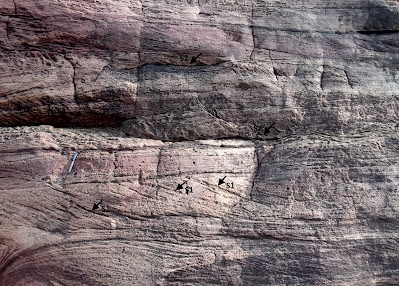
Sedimentation is an inherently episodic process with periods of non-deposition alternating with sediment accumulation. See this close up of an outcrop of a cross bedded sandstone from the Badami area in Karnataka.  


These sediments were deposited in a long lasting river system. Surfaces that result from non-deposition are marked as S1, S2.  In this hierarchical scheme, S1 spans perhaps a few minutes to a few hours and is a break in deposition on the lee side of  migrating ripples due to fluctuations in current energy. The S2 surface has developed over the channel sand body and spans months to years and represents seasonal fluctuations in currents or even a long drought which dries up the channel. 

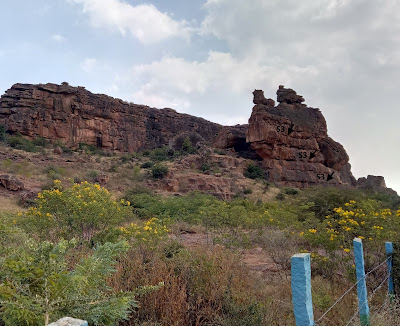
 Now, cast  your eye on this larger outcrop of the Badami sandstone. 

 
It has formed by the stacking of smaller sandstone units, each containing several surfaces of non deposition. The higher order surface S3 in this thicker pile marks a longer period of non-deposition and indicates a shift in course of the river channel. Hundreds, even thousands of years will pass, before the channel migrates back to its original location and deposition resumes at that locale.

Although I may be amiss in my specific interpretation of these surfaces of non-deposition, what I want to convey is that sediment deposition in all types of environments is interrupted by periods of non-deposition ranging from a few minutes, to thousands, even millions of years. The vast majority of elapsed time a sedimentary succession represents may be accounted for by periods of non-deposition and erosion. 

The Kaimur, Rewa and Bhander collectively account for a 60 million year time-span. If the revised age range for the Upper Vindhyans is correct then there were gaps of hundreds of millions of  years between the deposition of these Groups.

But these very long breaks invariably result due to tectonic uplift and cause pronounced erosion and chemical alteration of the exposed sedimentary surface. In outcrop it is recognizable as an undulating surface with the debris of weathering consolidated into hard soils, and in the formation of solution pits in limestone terrains. Such basin wide surfaces of marked erosion have not been found separating the Kaimur and the Rewa, and between the Rewa and the Bhander strata. 

Smaller breaks though do occur. Chandan Chakraborty in a study of sedimentary cycles of the Vindhyan Basin finds an angular discordance between the Kaimur and the Rewa, and the Rewa and the Bhander. However, this is restricted only to the south of the Vindhyan Basin. The discordance between the older and younger sequences dies out towards the north. This stratigraphic relationship  suggests that the tectonic movements were contemporaneous with sedimentation. The basin floor was tilted up on one side interrupting sedimentation and eroding the exposed strata there, while at the other end (north), subsidence and deposition continued. The periods of non-deposition and erosion between these sequences was a more localized event, lasting few millions of years at most. The kind of tectonic upheavals that may halt deposition for hundreds of millions of years across the entire basin are simply not attested to in the stratigraphic record of the Upper Vindhyans. 

It seems to me, and I say this mischievously, that the earlier estimate of 1000-900 million year age of the uppermost Bhander strata and for the end of Vindhyan sedimentation sounds quite reasonable! 

How secure is the finding of Dickinsonia and the assigned Ediacaran age of the Bhander Group? I am in no way trying to rebut this finding. The microbial fossil Arumberia found in the Bhander is considered by experts to be a reliable Late Ediacaran age indicator. However, the identification of Dickinsonia is based on a 3D digital reconstruction of photographs taken at the site of discovery. Due to the protected status of the Bhimbetka Caves, the scientists were unable to excavate the impression and subject it to a physical examination or a chemical test for organic residue. This is the only report of Dickinsonia from the entire Vindhyan Basin.

The young 548 million year date of the detrital zircon is based on one grain. The researchers are confident of their analysis and see no reason to reject this data point, though they admit that further corroboration of this date will be necessary given that previous studies did not report such young zircons from the Bhander strata. Curiously, no source terrain of this young zircon is identified in the paper.  

The news about Dickinsonia received wide coverage in India. That was expected given the long standing uncertainty of the age of the Vindhyans and the importance of the fossil for understanding early animal evolution and Ediacaran ecology and paleogeography.  But these new proposed timelines have thrown up a puzzle about rates of accumulation of sedimentary sequences and magnitudes of intervening breaks. We are quick to appreciate changes in sedimentary layer color, their structures, and their geometry, and interpret these changes in the context of fluctuating depositional conditions. But what about surfaces of non-deposition? Do they have anything valuable to contribute to our understanding of geological processes. 

The paleontologists Niles Eldredge and Stephen Jay Gould once perceptively observed that 'stasis is data'. The unchanging morphology of many fossil species lineages tell us something about the mode and tempo of evolution. Geological surfaces of stasis, when sedimentation has come to a standstill, are richly informative too in their own way. Surfaces representing very long time-spans may develop during convulsions in the earth's crust and periods of mountain building. The soils that often mantle such surfaces archive information about past climate and terrestrial life. Breaks of smaller and smaller time-spans like wise have a variety of drivers such as orbital control on climate and sea level, migration of depositional environments, and even tidal cycles.  

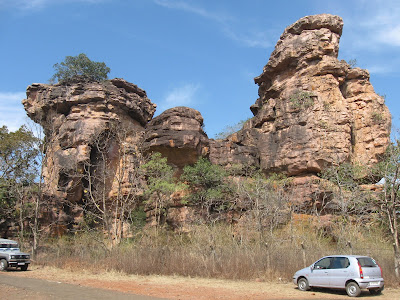
How many more hiatuses of unknown duration lie hidden within the Vindhyan sediment pile?  They may mark phases when no sediment accumulated but they are as much an integral part of basin history as are the iconic sandstone faces of Bhimbetka.

 

Friday, February 19, 2021

Fossil Dickinsonia in Bhimbetka Sandstones: Nature India Article

 My short piece published in Nature India on the surprising report of Ediacaran age fossil Dickinsonia in the Bhimbetka caves near Bhopal, Central India, and its geological and biological significance.

an excerpt:

"The biological affinity of Dickinsonia is controversial. Most scientists tend to accept it as an early animal. Some like Gregory Retallack, co-discoverer of this fossil, think of it to be a large algae or lichen. He argues that the mainstream view that Dickinsonia was a marine animal is based on weak evidence, while his own detailed work shows that Dickinsonia was a land creature, forming biogenic crusts on soils. Interestingly, the Bhimbetka rocks were deposited in a mostly terrestrial setting, more in alignment with Retallack's interpretation. Importantly for geology, its restricted time span, being found only in rocks between 555-550 million years old, makes it a diagnostic age indicator. So far, no animal fossils have been found in the Vindhyan rocks. This finding may inspire geologists to start searching contemporaneous Indian basins afresh for such subtle clues".

Fossil from dawn of animal life found in India’s famous caves.

Wednesday, January 27, 2021

Fossil Dickinsonia Indicates Ediacaran Age For Upper Vindhyans

 It looks like one of the long running debates in Indian stratigraphy has been resolved. 

The Vindhyan Basin is one of several Proterozoic age basins in Peninsular India. The youngest rocks in this basin have been accepted to be of Neoproterozoic age i.e. less than 1 billion years old. But absolute dating of these rocks is tough. Criteria like youngest detrital zircon ages, which tell us the age of the youngest source rocks from which sediments were derived, were hinting at an age of about 850- 900 million years for the uppermost Vindhyan strata. On the other hand, presence of fossils like Arumberia and Beltanelliformis minuta, both considered microbial organisms, were suggesting of an Ediacaran age (637-541 million years) for youngest Vindhyan rock units, although there wasn't a widespread acceptance of these dates. Then, last year, a paper by Lan and colleagues published new detrital zircon dates of 548 million years from the Maihar Sandstone. They indicated that the uppermost Vindhyans are late Ediacaran in age. Detrital zircon age tells us that the sediment cannot be older than the zircon, i.e. it gives a maximum age for the deposition of the sedimentary layer.

Now, a stunning fossil find seems to confirm this chronology. The Ediacaran age fossil Dickinsonia has been dated to about 555 million years from sites in Russia. This fossil was found as impressions on Maihar Sandstone at the site of Bhimbetka in Madhya Pradesh. Bhimbetka caves are famous for pre-historic cave art. Gregory Rettalack and colleagues report Dickinsonia, in their own words.. " hiding in plain sight, on the roof of the Audi-torium Cave (N22.938402° E77.613504°), the first of several Paleolithic and Mesolithic cave painting and petroglyph sites on the path into Bhimbetka Rock Shelters"..

The fossils remain in place at the site as negative relief impressions and has been documented photographically (pics below).


            Source: Retallack G. et.al., 2021: Dickinsonia discovered in India and late Ediacaran biogeography.

The biological affinity of Dickinsonia is contested. Some paleobiologists think it is a representative of an extinct group of early animals. Others think it is likely to be a macro algae. No unequivocal indicators of animal life, either in the form of body or trace fossils, has been found in the Vindhyan Basin so far. Such a recent age for the uppermost Vindhyan strata may renew hope that the earliest stages of animal evolution are preserved in these rocks. 

I had written a long post on the age problem of the upper Vindhyans some time back. In that I had mentioned that physical signals like magnetic signatures and chemical criteria like carbon isotope trends were suggestive of the uppermost Vindhyans being not much younger than 850 million years. But similar magnetic signals and carbon isotope trends may be repeatedly produced under similar physical and chemical conditions.

Fossils are a better guide to age. Evolution produces unique life forms. Species exist over a restricted time range. This is the basis for constructing a relative time scale for global strata. Presence of the same species or same group of organisms in physically disconnected rocks indicate contemporaneity of these units. To ascertain their absolute age they need to be dated using one or more of radiogenic dating methods, usually relying on interlayered volcanic ash which contains the  appropriate minerals. Or, as in this case, using detrital zircon, which gives us the maximum age of the unit.  Global surveys of late Neoproterozoic strata show that Dickinsonia is not found in rocks younger than about 550 million years. This brackets the age range of the Dickinsonia containing unit of the Maihar Sandstone at Bhimbetka to between 555 -550 million years. Detrital zircon ages of 548 million years for Maihar Sandstone indicate that Vindhyan sedimentation continued for some time after.

I find myself compelled to ask one question here. What is the source of the 548 million year old zircons reported from the Maihar Sandstone? I haven't read Lan et. al.'s paper, so I am guessing. The age of the youngest zircons from the Aravalli and Central Indian terrains which were the main source of sediments supplied to the Vindhyan Basin are about 800- 900 million years. The Bastar region could be one source for these even younger zircons. High grade gneiss and granitoids from this craton have yielded 500 million year old zircons likely produced during the collision of the Eastern Ghat terrain with the eastern margin of India. Or perhaps they were sourced from terrains which are now far far way in Antarctica.

There are other Proterozoic basins in Peninsular India where age uncertainties of especially the uppermost units continue to be the subject of lively debate. This fossil find might just inspire geologists to start a fresh search for hitherto elusive age indicators.

Friday, February 7, 2020

Sea Water Chemistry Triggers For Evolution Of Biomineralization

Geological Processes and Evolution #20

The bulk of the shells and skeletons of marine creatures are built out of aragonite or high-Mg calcite (> 4 mole% MgCO3) or low-Mg calcite. These three calcium carbonate minerals, along with dolomite (calcium magnesium carbonate), also occur as marine cements, i.e., they are precipitated from sea water as mineral grains in the open spaces between shell particles, resulting in loose sediment getting bound in to hard rock.

I came across this paper by Rachel Wood and colleagues from 2017 on the link between sea water chemistry and the evolution of biomineralization as evidenced in the limestone strata from Siberia. The time period is from 545 million years ago to 500 million years ago, a span in which early animals began secreting calcium carbonate skeletons. What were the main triggers for this evolutionary change?

Abstract:

The trigger for biomineralization of metazoans in the terminal Ediacaran, ca. 550 Ma, has been suggested to be the rise of oxygenation or an increase in seawater Ca concentration, but geochemical and fossil data have not been fully integrated to demonstrate cause and effect. Here we combine the record of macrofossils with early marine carbonate cement distribution within a relative depth framework for terminal Ediacaran to Cambrian successions on the eastern Siberian Platform, Russia, to interrogate the evolution of seawater chemistry and biotic response. Prior to ca. 545 Ma, the presence of early marine ferroan dolomite cement suggests dominantly ferruginous anoxic “aragonite-dolomite seas”, with a very shallow oxic chemocline that supported mainly soft-bodied macrobiota. After ca. 545 Ma, marine cements changed to aragonite and/or high-Mg calcite, and this coincides with the appearance of widespread aragonite and high-Mg calcite skeletal metazoans, suggesting a profound change in seawater chemistry to “aragonite seas” with a deeper chemocline. By early Cambrian Stage 3, the first marine low-Mg calcite cements appear, coincident with the first low-Mg calcite metazoan skeletons, suggesting a further shift to “calcite seas”. We suggest that this evolution of seawater chemistry was caused by enhanced continental denudation that increased the input of Ca into oceans so progressively lowering Mg/Ca, which, combined with more widespread oxic conditions, facilitated the rise of skeletal animals and in turn influenced the evolution of skeletal mineralogy.

Dolomite abundance through geologic time shows a positive correlation with periods of ocean anoxia. One reason could be that sulphate reducing bacteria which thrive in anoxic environments remove dissolved sulphate which interferes with dolomite formation. A 'shallow oxic chemocline' means that only the shallows were oxygen rich, while deeper water were oxygen poor or anoxic. These conditions changed after about 545 million years ago with increasing oxygen in even deeper waters thus increasing habitat suitable for the evolution and spread of oxygen demanding animals. Sponges may have played an important role in the ventilation of the water column by actively removing suspended organic matter during filter feeding, thus making more oxygen available to be transferred to deeper waters.

The terms "aragonite-dolomite seas", "aragonite seas" and "calcite seas" refer to geologic time-bound conditions facilitating the precipitation of marine cements of that mineralogy. Excessive magnesium is a hindrance to formation of calcite and a lowering of Mg/Ca meant a shift from "aragonite seas" to "calcite seas". From Cambrian to recent times, periodic swings in Mg/Ca of sea water has caused either aragonite or calcite to become the dominant marine precipitate.  

It is notable that the mineralogy of skeletons when they first evolve in a particular animal group seems to be determined by the prevailing sea water chemistry. Animal groups like the molluscs which acquired the ability to biomineralize during 'aragonite-high Mg calcite seas' of the late Ediacaran -Early Cambrian (550-520 million years ago) used these minerals to build their skeletons. Later in the Paleozoic, sea water chemistry changed to favor the precipitation of low Mg calcite. Animal groups like the trilobites, echinoderms, brachiopods and tabulate corals that first evolved skeletons during this time period (Early Mid Cambrian to Ordovician, ~520-450 million years ago) began using low-Mg calcite as their shell mineral.

The graphic shows the first appearance of carbonate skeletal groups with their inferred primary mineralogy plotted against the temporal distribution of aragonite and calcite seas (inferred from marine cements).


Source: Susannah M. Porter 2010: Calcite and aragonite seas and the de novo acquisition of carbonate skeletons.

Interestingly, once acquired, animals did not switch their shell mineralogy to match subsequent changes in sea water chemistry. Most aragonite shell secreting animals retained this mineralogy during later 'calcite seas' (e.g. Ordovician to early Permian and Jurassic-Cretaceous) and vice versa ('aragonite seas'- Permian-Triassic, Cenozoic). A wholesale change in skeletal mineralogy may require too many evolutionary steps and would be physiologically demanding. Conserving mineralogy even during changing ambient conditions is likely an evolutionary trade off.

One question remains unanswered. There is evidence as early as 560 million years ago of soft bodied animals making tracks and burrows on the sea floor. If sea water chemistry then was conducive for the precipitation of early dolomite, why didn't at least some early animal groups make skeletons out of dolomite? Perhaps the answer lies in mineral kinetics. Dolomite is slow to precipitate. Its atomic structure is made up of layers of calcium carbonate alternating with layers of magnesium carbonate. This is more difficult to build than the relatively simpler structures of aragonite and calcite which are made up of only calcium carbonate with a few magnesium ions substituting for calcium.

In latest Ediacaran-early Cambrian times, as oxygen levels rose and animal diversity increased, ecologic interactions became more complex. The rise of predators and predator-prey arms races would have favored the evolution of a protective shell that could be assembled rapidly. Faster precipitating minerals like aragonite and calcite became the fixed construction material.

Open Access.

Monday, June 11, 2018

550 Million Year Old Animal Tracks Preserved In Sediments

Late Ediacaran trackways produced by bilaterian animals with paired appendages - Zhe Chen, Xiang Chen, Chuanming Zhou2, Xunlai Yuan and Shuhai Xiao

Pretty exciting find this. One of the earliest evidence of the presence of bilateral animals on earth has been found in 550 - 540 million  year old sedimentary rocks from China. These are not body fossils. Rather a pair of pits impressed upon the sediment surface mark the movement of an animal with paired appendages.

Abstract:

Ediacaran trace fossils provide key paleontological evidence for the evolution of early animals and their behaviors. Thus far, however, this fossil record has been limited to simple surface trails and relatively shallow burrows. We report possible trackways, preserved in association with burrows, from the terminal Ediacaran Shibantan Member (ca. 551 to ca. 541 million years ago) in the Yangtze Gorges area of South China. These trace fossils represent the earliest known trackways. They consist of two rows of imprints arranged in poorly organized series or repeated groups. These trackways may have been produced by bilaterian animals with paired appendages, although the phylum-level phylogenetic affinity of the trace makers remains unknown. It is possible that the trackways and associated burrows were produced by the same trace maker, indicating a complex behavior involving both walking and burrowing. Together, these trackways and burrows mark the arrival of a new era characterized by an increasing geobiological footprint of bilaterian animals.


 Source: Zhe Chen et.al. 2018

To put this find in context to the broader trajectory of animal evolution. These sediments are 30-40 million years older than the Chengjiang Biota of China and the famous Burgess Shale of Canada. These two are known for their exceptional preservation of animal soft tissue, giving scientists a peek into the morphological diversity present at that time. However, animals did not suddenly originate during the time the Chengjiang Shale and the Burgess Shale were being deposited, as is sometimes misunderstood by some, or is deliberately and disingenuously argued by creationists.

Molecular clocks which can estimate the time of origin and divergence of organisms suggests that animals diverged from a common ancestor between 1000 million and 700 million years ago. Trace and body fossils start appearing by 600 million years ago.

I like to put up this figure which summarizes the fossil record of early animal evolution through the Late Neoproterozoic to Early-Mid Cambrian


Source: On The Origin of Phyla

You will notice an incremental increase in richness of the trace and body fossil record. The Cambrian "Explosion" was a geologically rapid diversification of the animal biosphere, fueled by a confluence of ecologic triggers. But in absolute years it took place over a 15-20 million year period.

Tuesday, December 6, 2016

Wormworld: Biological Transitions At The Precambrian-Cambrian Boundary

The earliest animals were worms and they had a profound impact on marine ecosystems.

The many theories and some new understanding on the always fascinating topic of early animal evolution has been summarized quite well in a paper by James Schiffbauer and colleagues.

Molecular divergence time estimates (e.g., Erwin et al., 2011;Peterson et al., 2008) suggest that the last common ancestor of all animals evolved in the Cryogenian (ca. 800 Ma; although see dos Reis et al., 2015, for caveats). The earliest interpreted stem-group animals, however, are the ca. 600 Ma Doushantuo embryo-like microfossils (Chen et al., 2014a; Yin et al., 2016), leaving a
200-m.y. interlude between the fossil and molecular records. This hiatus between the estimated origin of Metazoa and their first appearance in the fossil record highlights the growing realization that the earliest stages of animal diversification were neither truly Cambrian nor explosive—with the phylogenetic origin of animals temporally removed from their morphological and ecological diversification by a long fuse (e.g., Conway Morris, 2000; Xiao, 2014). 


In this case, the significant lag between the establishment of the developmental toolkits necessary for the origin of novelty and their later implementation and ecological success can perhaps be attributed to the uniqueness of newly developing animal ecosystems. Between the ignition of the fuse and the subsequent evolutionary boom, three major eco-environmental feedbacks (see Erwin et al., 2011) arose that helped to pave the way for the Cambrian Explosion: (1) linkages between the pelagic and benthic ecosystems; (2) expansion of ecosystem engineering; and (3) metazoan macropredation. These feedbacks are explored herein in the context of the terminal Ediacaran fossil
record of vermiform organisms. This “wormworld” biota— comprised of various tubicolous body fossils (Figs. 2A–2C), such as the cloudinids, and increasingly complex vermiform ichnofossils (Figs. 2D–2F)—critically occupied a fundamental phase shift from competition- to predation-governed marine benthic ecosystems.


What was the big change in macroscopic life habits from the Precambrian to Cambrian times? Macroscopic multicellular life of the Ediacaran was dominated by benthic sessile forms. Early Cambrian animals were mobile creatures engaged in predation, burrowing, grazing and reef building. These activities resulted in an ecosystem engineering of sorts. For example; a) grazing and burrowing activity churned up sediment and oxygenated it. b) the evolution of guts in bilaterians transferred nutrients from sea water to the sediment in the form of fecal pellets.  These life modes created new ecologic niches and opened up new potential evolutionary pathways.

..And what killed out the classic Ediacaran biota. Was is environmental changes or ecologic competition from early animals?

It is important to note that the suggested mass extinction of the Ediacara biota in the context of our wormworld model is an ecologically driven event rather than an environmentally driven cataclysm akin to more recent (Phanerozoic) mass extinctions, and thus may have been comparatively protracted—as evidenced by Ediacara holdovers in the early Cambrian (Conway Morris, 1993; Hagadorn et al., 2000; Jensen et al., 1998). Nonetheless, whereas the static synecology and comparatively passive feeding modes of the classic Ediacarans had once emplaced a boundary on evolutionary possibility, the successful expansion of innovative traits of herbivory and carnivory, and their causal ties to infaunalization, reef-building, and biomineralization, permitted a new scaling of this bounding “right wall” (sensu Knoll and Bambach, 2000) as realized by the organisms of the wormworld fauna. Over time, the evolutionary breakthroughs conveyed by these neoteric organisms, including novel strategies, behaviors, and physiologies, increased the heterogeneity of benthic ecosystems, allowed for enhanced exploitation of resources, and established insurmountable increases in ecospace that ultimately signaled the curtain call for the Ediacara-type guilds.

The question of extinction of Ediacaran biota though may be more open ended than that suggested in this paper. E F Smith and colleagues in a recent issue of Geology analyze carbon isotope signatures of a carbonate succession spanning the Precambrian-Cambrian boundary. They find the carbonate sediment have pronounced negative carbon isotope values signalling a collapse or significant decrease in primary productivity in the oceans. 

What is the link between ecosystem collapse and negative carbon isotope excursion in carbonate sediment? Organic tissue preferentially incorporates C12, the lighter isotope of carbon. That means in thriving ecosystems, life is using up C12 from sea water and less of it makes its way into growing CaCO3 crystals forming carbonate sediment on the sea floor. When ecosystems collapse due to a myriad of reasons resulting in mass extinction, there is more C12 available to get incorporated into carbonate sediment. This increase in the lighter isotope C12 is a negative excursion of del13C, the ratio of C13 to C12.

Additional environmental disturbances may also contribute C12 to sea water. Warming of ocean water may lead to thawing of gas hydrates trapped below the sea bed. Methane released from hydrates is isotopically light and may break down and contribute C12 that eventually makes its way into carbonate. On land, a collapse of vegetation may release pulses of lighter carbon to the sea. Such a scenario would be realized in post Silurian times after the evolution of land vegetation.  In short, environmental catastrophe is linked to disturbances of the carbon cycle, and many sources may provide C12 to marine carbonate being formed at that time.

Anyways, what that means is that the decline in Ediacaran biota may have been due to both an environmental calamity as well as by longer term persistent competition by early animal activity.

And here is an infographic that summarizes the significant geological, ecological and biological events spanning the Precambrian-Cambrian transition


Source: Schiffbauer et al 2016

Open Access.