Showing posts with label Neoproterozoic. Show all posts

Monday, April 28, 2025

Oldest Himalaya Rocks

In Peninsular India, the most significant change in rock type occur across what is known as the Archean Proterozoic boundary.

Archean rocks, older than 2.5 billion years, are typically varieties of granite and granite gneiss. They formed when the earth was much hotter and silica rich continental crust was growing by injections of magma from the uppermost mantle and by partial melting of older mafic (silica poor) crust. At places the crust subsided by vertical movements, and lava and sediment filled the narrow depressions. These volcano-sedimentary rocks were deformed and metamorphosed to form linear schist enclaves within the granitic crust. The term granite greenstone terrain describes this rock association.

This phase of continental crust building petered out by around 2. 5 billion years ago. The thick crustal blocks or cratons became the nuclei for future continent growth. By 2 billion years ago or so in the Paleoproterozoic (the Proterozoic Eon spans from 2.5 billion years ago to 538 million years ago) , the Archean crust became the floor for several sedimentary basins. Erosion of the Archean rocks provided sediments that accumulated in these basins over the next 1 billion years, with long hiatuses punctuating pulses of sediment deposition. The names of these sites of deposition will be familiar to many readers and travelers.  Aravallis, Vindhyans, and Cuddapah, to name a few, represent this younger Proterozoic phase of crustal recycling. 

There was limited development in Peninsular India of younger sedimentary basins and as a result Archean and Proterozoic crustal sections are widely exposed all across the country.

The satellite imagery posted below shows one classic locality of the Archean Proterozoic boundary. This is from the Cuddapah Basin of South India.  

The Archean granitic terrain has a rough texture due to the bouldery nature of the landscape formed by weathering of fractured granite. Towards the east north east, the layering of sedimentary strata of the Cuddapah Basin is prominent and unmistakable.  The following graphic is a geologic log prepared to describe the succession of rock types from the Cuddapah Basin.

Source: Vivek S Kale and coworkers; Proc. Indian. Nat. Sci. Academy 2020.

Archean 'basement' and Proterozoic 'cover sequence' is a common stratigraphic motif of the Precambrian geology of India.

A few weeks ago I found an old paper from the 1970's on the sedimentology and stratigraphy of Tethyan sequences from the Kali valley area, near the Kumaon Nepal border. These are, as the name suggests, sediments deposited in the Tethyan Ocean along the  northern margin of the Indian continent. They range in age from the Proterozoic to the Mesozoic.

Here is the stratigraphic column from the paper. I have shown only the Precambrian (Archean and Proterozoic collectively make up the Precambrian) section of the column. The Central Crystallines are assigned an Archean age, while the Tethyan Sequence Martoli Formation is Early Precambrian. The name Proterozoic was not in use in the 1970's when this paper was written.

 Source: S. Kumar and coworkers; Journal of Paleontological Society of India 1977.

'Crystalline' in this context refers to the rock texture made up of large interlocking minerals formed during slow cooling of a magma or during high temperature metamorphism of a sedimentary rock.

The geologic sequence I described earlier took place along the northern margin of India too where the future Himalaya would form. At first glance the Himalaya sequence seems a replica of the geology of Precambrian Peninsular India. It records an Archean  'crystalline'  basement, succeeded by variably deformed and metamorphosed Precambrian (Proterozoic) sediments.

Except that it is wrong. There are no Archean age rocks exposed anywhere in the Himalaya. And the rock units immediately in contact with the Archean are not Early Precambrian.

When this paper was published there was precious little geochronology work done in the Himalaya. Geologists knew from sporadic absolute dating of Peninsular rocks that the granite and granite gneiss terrains are older than 2.5 billion years  (Archean).  The thick sedimentary sequences overlying the granite basement also were Precambrian as ascertained by dating intrusive granites and interbedded lava layers. The lack of any shelly fossils in them was another indicator of the Precambrian age of the cover sedimentary sequences. 

Given this familiarity with Peninsular geology, it would have been natural to assign the same chronology to a Himalaya rock sequence of high grade gneiss in contact with unfossiliferous sedimentary rocks. 

The Central Crystallines are now known as the Greater Himalaya Sequence and they are not Archean but Neoproterozoic (Late Precambrian) in age. Detailed work has shown that they represent sediments deposited roughly between 1 billion and 600 million years ago along the northern continental shelf of India. A paleogeographic reconstruction of the Himachal Himalaya by Alexander Webb and coworkers shows the original disposition of the different Himalaya rock divisions. Observe (A) that the Greater Himalaya (GHC) and the lower part of the Tethyan Himalaya (Haimanta/Martoli Formation) were deposited synchronously in adjacent areas of the continental shelf.  

 Source: Alexander Webb and coworkers; Geosphere 2011.

They look very different from each other today because they experienced different conditions during Himalaya mountain building. The Central Crystallines which began their life as marine sediments became crystalline gneisses and schists during high grade Cenozoic metamorphism 35 to 20 million years ago, while the Tethyan Sequence escaped being buried deep in the crust and retained much of their original sedimentary character. 

What about the oldest Himalaya rocks? These are Paleoproterozoic in age, dated to be about 1.9 to 1. 8 billion years old. The units Damtha, Berinag, Wangtu, Jeori and Baragaon in the Himachal Himalaya cross section are the Paleoproterozoic age rocks. They are remnants of a magmatic arc and associated basins which formed along the northern margin of India when continental blocks were colliding and suturing into an early supercontinent named Colombia.

Underneath these Paleoproterozoic rocks would have been the Archean 'basement'. But where is it now? 

We can take a step back and understand how the Himalaya are constructed. As the Indian continental crust collided and pressed into Asia, a crack or a fault initiated in the collision zone started propagating southwards, slowly splitting the Indian crust.  As India kept getting pushed under Asia along this master fault, slices of Indian crust get scraped off  and thrust upwards along subsidiary faults to form a growing mountain range. This tectonic evolution is depicted as stages B, C, D, E, F. You can also read my post Himalaya: A Critical Wedge for more details on the mechanisms of mountain building.

If as shown in the cross section, the faults that break and transport crustal sheets are located entirely within the Proterozoic and younger layers then the Archean rocks won't get incorporated into the Himalayan orogen. They lie below the basal detachment/master fault. Alternatively, this model may not be applicable everywhere in the Himalaya and there may be slivers of Archean rocks buried deep under the thrust pile, but erosion hasn't exposed them yet. 

In the geologic future, the plate tectonic engine that made the Himalaya will change track. The mountain ranges will stop growing. Erosion will wear down the Himalaya and eventually lay bare its roots. The Archean 'crystalline basement' so familiar all over Peninsular India will also be visible at the base of the gentle rolling hills that were once the mighty Himalaya.
Tuesday, February 22, 2022

Marking Vindhyan Time

About this time last year I wrote a piece for Nature India on the discovery of the fossil Dickinsonia from the uppermost Vindhyan strata exposed at Bhimbetka caves in Central India. Dickinsonia is considered to be an early animal that lived between 560 to 550 million years ago. This finding seems to confirm an Ediacaran age  (635-541 million years ago) for the youngest Vindhyan strata, termed formally as the Bhander Group. Earlier thinking was that these rocks are 1000 to 900 million years old! 

I have been thinking on and off about this discovery, not as much doubting it as trying to understand its implication from a different angle, that of the ways in which sediments accumulate in a basin and how the passage of time is recorded in sedimentary successions. 

The sedimentary rocks of the Vindhyan Basin have been subdivided by field geologists into four units based on characteristic sediment associations. From the oldest to the youngest, these are, the Semri Group, the Kaimur Group, the Rewa Group, and the Bhander Group.  Deposition of the Semri sediments began around 1700 million years ago and ended by 1600 million or so. Tectonic movements then uplifted, tilted, and eroded these rocks. Between 1200 million and 1100 million years ago the basin floor subsided and new sediment was deposited on the inclined layers of the Semri Group. There is thus a marked  'angular unconformity' between Semri and the overlying Kaimur strata, marking two distinct phases of basin history separated by 400 million years.

The age of Kaimur, Rewa and Bhander Groups, which are often referred to as the Upper Vindhyans, has been more difficult to pin down due to a lack of reliable radiogenic dating and age diagnostic biota. Despite this, a combination of magnetic properties, a few Uranium series dates from limestones, and the age ranges from zircon found in Bhander sandstones,  hinted that the youngest Vindhyan sediments are about 900 million years old.

The fossil Dickinsonia has upended this assumption and appears to have expanded the life of the Vindhyan Basin by a whopping 350-400 million years. This revision has been bolstered by two other age criteria. Microbial fossils typical of the Ediacaran Period have been reported from the Bhander. And secondly, in the year 2020, a detrital zircon dated to 548 million years ago was recovered from the Bhander. Zircons form in magmas or during high temperature metamorphic reactions. The mineral is then eroded away from these source rocks and deposited as a sedimentary particle in adjacent basins. The youngest zircon population in a sedimentary layer sets its maximum age,  since the strata cannot be older than the detritus it is made up of. It could be much younger than the contained zircon, but in this case a lack of Cambrian fossils has constrained the age of the Bhander to be older than 541 million years ago.

Let me now dive in to what has been pricking my geological curiosity. The Kaimur, Rewa and the Bhander are thought to be three distinct episodes of sedimentation. Stratigraphers may recognize them as 'depositional sequences' formed when accommodation space for sediment to accumulate is being created either by the basin floor sinking due to tectonic movements or due to eustatic (global) sea level changes. 

Such depositional sequences are building blocks of sedimentary successions in basins of all ages, each episode lasting at most few tens of million of years. V.S. Kale in a discussion note on Indian Purana basins points out that the physical characters of the sediments are not suggestive of slow sedimentation rates, and given their thickness, estimates that these sequences span 10-20 million years each. Even assigning the upper limit, Kaimur, Rewa and Bhander were deposited in about 60 million years or so. If Upper Vindhyan sedimentation began around 1200 -1100 million years ago and ended by 550-540 million years ago, that leaves about 550 million years of unrecorded elapsed time.

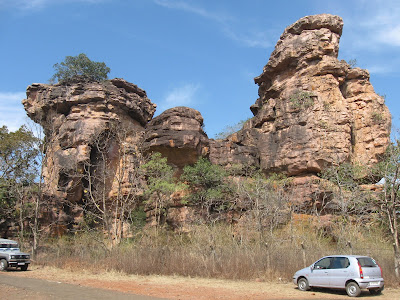
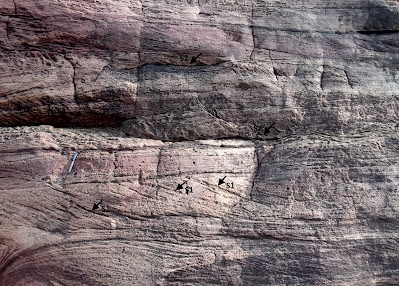
Sedimentation is an inherently episodic process with periods of non-deposition alternating with sediment accumulation. See this close up of an outcrop of a cross bedded sandstone from the Badami area in Karnataka.  


These sediments were deposited in a long lasting river system. Surfaces that result from non-deposition are marked as S1, S2.  In this hierarchical scheme, S1 spans perhaps a few minutes to a few hours and is a break in deposition on the lee side of  migrating ripples due to fluctuations in current energy. The S2 surface has developed over the channel sand body and spans months to years and represents seasonal fluctuations in currents or even a long drought which dries up the channel. 

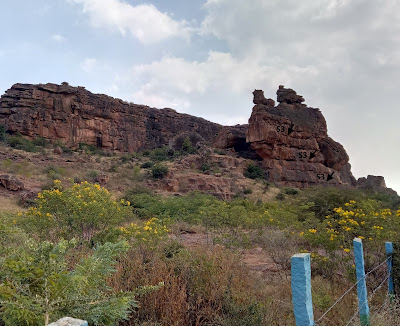
 Now, cast  your eye on this larger outcrop of the Badami sandstone. 

 
It has formed by the stacking of smaller sandstone units, each containing several surfaces of non deposition. The higher order surface S3 in this thicker pile marks a longer period of non-deposition and indicates a shift in course of the river channel. Hundreds, even thousands of years will pass, before the channel migrates back to its original location and deposition resumes at that locale.

Although I may be amiss in my specific interpretation of these surfaces of non-deposition, what I want to convey is that sediment deposition in all types of environments is interrupted by periods of non-deposition ranging from a few minutes, to thousands, even millions of years. The vast majority of elapsed time a sedimentary succession represents may be accounted for by periods of non-deposition and erosion. 

The Kaimur, Rewa and Bhander collectively account for a 60 million year time-span. If the revised age range for the Upper Vindhyans is correct then there were gaps of hundreds of millions of  years between the deposition of these Groups.

But these very long breaks invariably result due to tectonic uplift and cause pronounced erosion and chemical alteration of the exposed sedimentary surface. In outcrop it is recognizable as an undulating surface with the debris of weathering consolidated into hard soils, and in the formation of solution pits in limestone terrains. Such basin wide surfaces of marked erosion have not been found separating the Kaimur and the Rewa, and between the Rewa and the Bhander strata. 

Smaller breaks though do occur. Chandan Chakraborty in a study of sedimentary cycles of the Vindhyan Basin finds an angular discordance between the Kaimur and the Rewa, and the Rewa and the Bhander. However, this is restricted only to the south of the Vindhyan Basin. The discordance between the older and younger sequences dies out towards the north. This stratigraphic relationship  suggests that the tectonic movements were contemporaneous with sedimentation. The basin floor was tilted up on one side interrupting sedimentation and eroding the exposed strata there, while at the other end (north), subsidence and deposition continued. The periods of non-deposition and erosion between these sequences was a more localized event, lasting few millions of years at most. The kind of tectonic upheavals that may halt deposition for hundreds of millions of years across the entire basin are simply not attested to in the stratigraphic record of the Upper Vindhyans. 

It seems to me, and I say this mischievously, that the earlier estimate of 1000-900 million year age of the uppermost Bhander strata and for the end of Vindhyan sedimentation sounds quite reasonable! 

How secure is the finding of Dickinsonia and the assigned Ediacaran age of the Bhander Group? I am in no way trying to rebut this finding. The microbial fossil Arumberia found in the Bhander is considered by experts to be a reliable Late Ediacaran age indicator. However, the identification of Dickinsonia is based on a 3D digital reconstruction of photographs taken at the site of discovery. Due to the protected status of the Bhimbetka Caves, the scientists were unable to excavate the impression and subject it to a physical examination or a chemical test for organic residue. This is the only report of Dickinsonia from the entire Vindhyan Basin.

The young 548 million year date of the detrital zircon is based on one grain. The researchers are confident of their analysis and see no reason to reject this data point, though they admit that further corroboration of this date will be necessary given that previous studies did not report such young zircons from the Bhander strata. Curiously, no source terrain of this young zircon is identified in the paper.  

The news about Dickinsonia received wide coverage in India. That was expected given the long standing uncertainty of the age of the Vindhyans and the importance of the fossil for understanding early animal evolution and Ediacaran ecology and paleogeography.  But these new proposed timelines have thrown up a puzzle about rates of accumulation of sedimentary sequences and magnitudes of intervening breaks. We are quick to appreciate changes in sedimentary layer color, their structures, and their geometry, and interpret these changes in the context of fluctuating depositional conditions. But what about surfaces of non-deposition? Do they have anything valuable to contribute to our understanding of geological processes. 

The paleontologists Niles Eldredge and Stephen Jay Gould once perceptively observed that 'stasis is data'. The unchanging morphology of many fossil species lineages tell us something about the mode and tempo of evolution. Geological surfaces of stasis, when sedimentation has come to a standstill, are richly informative too in their own way. Surfaces representing very long time-spans may develop during convulsions in the earth's crust and periods of mountain building. The soils that often mantle such surfaces archive information about past climate and terrestrial life. Breaks of smaller and smaller time-spans like wise have a variety of drivers such as orbital control on climate and sea level, migration of depositional environments, and even tidal cycles.  

How many more hiatuses of unknown duration lie hidden within the Vindhyan sediment pile?  They may mark phases when no sediment accumulated but they are as much an integral part of basin history as are the iconic sandstone faces of Bhimbetka.


Friday, February 19, 2021

Fossil Dickinsonia in Bhimbetka Sandstones: Nature India Article

 My short piece published in Nature India on the surprising report of Ediacaran age fossil Dickinsonia in the Bhimbetka caves near Bhopal, Central India, and its geological and biological significance.

an excerpt:

"The biological affinity of Dickinsonia is controversial. Most scientists tend to accept it as an early animal. Some like Gregory Retallack, co-discoverer of this fossil, think of it to be a large algae or lichen. He argues that the mainstream view that Dickinsonia was a marine animal is based on weak evidence, while his own detailed work shows that Dickinsonia was a land creature, forming biogenic crusts on soils. Interestingly, the Bhimbetka rocks were deposited in a mostly terrestrial setting, more in alignment with Retallack's interpretation. Importantly for geology, its restricted time span, being found only in rocks between 555-550 million years old, makes it a diagnostic age indicator. So far, no animal fossils have been found in the Vindhyan rocks. This finding may inspire geologists to start searching contemporaneous Indian basins afresh for such subtle clues".

Fossil from dawn of animal life found in India’s famous caves.

Wednesday, January 27, 2021

Fossil Dickinsonia Indicates Ediacaran Age For Upper Vindhyans

 It looks like one of the long running debates in Indian stratigraphy has been resolved. 

The Vindhyan Basin is one of several Proterozoic age basins in Peninsular India. The youngest rocks in this basin have been accepted to be of Neoproterozoic age i.e. less than 1 billion years old. But absolute dating of these rocks is tough. Criteria like youngest detrital zircon ages, which tell us the age of the youngest source rocks from which sediments were derived, were hinting at an age of about 850- 900 million years for the uppermost Vindhyan strata. On the other hand, presence of fossils like Arumberia and Beltanelliformis minuta, both considered microbial organisms, were suggesting of an Ediacaran age (637-541 million years) for youngest Vindhyan rock units, although there wasn't a widespread acceptance of these dates. Then, last year, a paper by Lan and colleagues published new detrital zircon dates of 548 million years from the Maihar Sandstone. They indicated that the uppermost Vindhyans are late Ediacaran in age. Detrital zircon age tells us that the sediment cannot be older than the zircon, i.e. it gives a maximum age for the deposition of the sedimentary layer.

Now, a stunning fossil find seems to confirm this chronology. The Ediacaran age fossil Dickinsonia has been dated to about 555 million years from sites in Russia. This fossil was found as impressions on Maihar Sandstone at the site of Bhimbetka in Madhya Pradesh. Bhimbetka caves are famous for pre-historic cave art. Gregory Rettalack and colleagues report Dickinsonia, in their own words.. " hiding in plain sight, on the roof of the Audi-torium Cave (N22.938402° E77.613504°), the first of several Paleolithic and Mesolithic cave painting and petroglyph sites on the path into Bhimbetka Rock Shelters"..

The fossils remain in place at the site as negative relief impressions and has been documented photographically (pics below).


            Source: Retallack G. et.al., 2021: Dickinsonia discovered in India and late Ediacaran biogeography.

The biological affinity of Dickinsonia is contested. Some paleobiologists think it is a representative of an extinct group of early animals. Others think it is likely to be a macro algae. No unequivocal indicators of animal life, either in the form of body or trace fossils, has been found in the Vindhyan Basin so far. Such a recent age for the uppermost Vindhyan strata may renew hope that the earliest stages of animal evolution are preserved in these rocks. 

I had written a long post on the age problem of the upper Vindhyans some time back. In that I had mentioned that physical signals like magnetic signatures and chemical criteria like carbon isotope trends were suggestive of the uppermost Vindhyans being not much younger than 850 million years. But similar magnetic signals and carbon isotope trends may be repeatedly produced under similar physical and chemical conditions.

Fossils are a better guide to age. Evolution produces unique life forms. Species exist over a restricted time range. This is the basis for constructing a relative time scale for global strata. Presence of the same species or same group of organisms in physically disconnected rocks indicate contemporaneity of these units. To ascertain their absolute age they need to be dated using one or more of radiogenic dating methods, usually relying on interlayered volcanic ash which contains the  appropriate minerals. Or, as in this case, using detrital zircon, which gives us the maximum age of the unit.  Global surveys of late Neoproterozoic strata show that Dickinsonia is not found in rocks younger than about 550 million years. This brackets the age range of the Dickinsonia containing unit of the Maihar Sandstone at Bhimbetka to between 555 -550 million years. Detrital zircon ages of 548 million years for Maihar Sandstone indicate that Vindhyan sedimentation continued for some time after.

I find myself compelled to ask one question here. What is the source of the 548 million year old zircons reported from the Maihar Sandstone? I haven't read Lan et. al.'s paper, so I am guessing. The age of the youngest zircons from the Aravalli and Central Indian terrains which were the main source of sediments supplied to the Vindhyan Basin are about 800- 900 million years. The Bastar region could be one source for these even younger zircons. High grade gneiss and granitoids from this craton have yielded 500 million year old zircons likely produced during the collision of the Eastern Ghat terrain with the eastern margin of India. Or perhaps they were sourced from terrains which are now far far way in Antarctica.

There are other Proterozoic basins in Peninsular India where age uncertainties of especially the uppermost units continue to be the subject of lively debate. This fossil find might just inspire geologists to start a fresh search for hitherto elusive age indicators.

Wednesday, January 22, 2020

Sedimentary Structures: Building Stones of Badami, Aihole And Pattadakal Temples

Is this sandstone slab in its original geological orientation (as when the sedimentary layers were deposited) or is it upside down? I'll answer this a little later, but first some background.


I recently visited the Chalukya style temples and rock cut monuments at Aihole, Pattadakal and Badami (6th -8th CE) in northern Karnataka and noticed some great sedimentary structures in the building stones. The term sedimentary structures refers to the shape and form sedimentary layers get sculpted into by the action of waves, currents, tides and wind during deposition of the sediment. The size of the deposited sedimentary particles and the orientation of layers are a reflection of both the vigor of the currents and waves and the direction of flow of water or wind.  


These monuments are made up of Neoproterozoic age (900-800 million year old) sandstones. Geologists have recognized using detailed sedimentological analysis that the sandstones formed mostly in a large braided river system that flowed in a northwesterly direction.

Between  roughly 1800 -800 million years ago, over the course of a billion years, the Indian continental crust sagged due to various tectonic forces to form several long lasting sedimentary basins. The Kaladgi Basin in which the Badami area sandstones were deposited is one such basin. The paleogeographic reconstruction below shows the position of the Indian continent at about one billion years ago and the location of the various sedimentary basins within it.


Source: Shilpa Patil Pillai, Kanchan Pande and Vivek S Kale: 2018: Implications of new 40Ar/39Ar age of Mallapur Intrusives on the chronology and evolution of the Kaladgi Basin, Dharwar Craton, India.

Much of this deposition took place in inland or epeiric seas that flooded the Indian continent. During intervals of sea level fall, rivers carved valleys and deposited coarse sediment. The Badami Cave sandstones are river deposits of the Kaladgi Basin. The stratigraphic column shows various sedimentary deposits of the Kaladgi Basin and their inferred environments of deposition.

Source: Shilpa Patil Pillai, Kanchan Pande and Vivek S Kale: 2018: Implications of new 40Ar/39Ar age of Mallapur Intrusives on the chronology and evolution of the Kaladgi Basin, Dharwar Craton, India.

The Badami braided river system was receiving sediment eroded from Archean age (>2.5 billion year old) rocks situated SE of the basin. These were granites, granodiorites, and low to medium grade metamorphic  rocks of the Dharwar craton (a large block of stable old continental crust). 

Land plants did not exist then. Weathered debris was moved quickly by surface flow into streams. Large sediment load, moving by traction i.e. by rolling and sliding on the stream bed, repeatedly choked the channels, forcing bifurcation of streams and formation of braids. Very broad braided rivers formed since there were no plants to stabilize banks.  The Badami sandstones (Cave Temple Formation) are technically known as arenites. This term indicates that the rock is made up of mostly coarse sand with very little finer sized mud. Accumulation of mostly coarser sand size and pebbly particles reflects a locale of repeated high discharges and vigorous currents which winnowed away the finer sized mud.  The braided river shown below as an example is from the Canterbury Plains of New Zealand.


 Source: Braided Rivers: What's the Story?

The Badami rocks preserve a record of  various subenvironments of this paleo-river. Picture shows channel and bar deposits in outcrop.


Source: Mukhopadhyay et. al. 2018; Stratigraphic Evolution and Architecture of the Terrestrial Succession at the Base of the Neoproterozoic Badami Group, Karnataka, India.

As river channels episodically migrated sideways and the basin floor subsided to accommodate more sediment, channel deposits and adjacent sand bars got stacked to form thick 'multi-story' sandstones. Each bed tells a story of a discrete depositional episode.


The arrangement of sand layers within each bed tells us about the subenvironments in which it formed and the energy and direction of water flow during deposition. I came across many types of these internal structures. I recognized tabular cross beds, trough cross beds, planar lamination and rippled beds. Water (or wind) can move & shape sand into piles or waves. Sand grains roll along the direction of flow, then avalanche down the steeper side (lee side) of the wave forming a layer inclined (cross) to the orientation of the main sand body. Successive avalanches form a set of cross beds. The graphic shows the formation of a set of cross beds.

 Source: Dr. Diane M Burns in Teaching Sedimentary Geology in the 21st Century.

Here is an example of cross beds from near the town of Badami.


And this one is from a building stone from Pattadakal temple.
 

Such cross beds were built by sediment avalanching on the lee side of migrating sand bars during high flow.

This picture show trough cross bedding from near the Badami cave complex. These represent the internal structure of migrating sinuous sand dunes on a channel floor. 


See this elegant explanation by Dawn Sumner, a sedimentologist at the University of California at Davis,  of how trough cross beds form.


Email subscribers who may not be able to see the embedded video, click on this link: Trough Cross Bedding Video.

And here is a beautiful example of trough cross bedding found in a Pattadakal temple building stone.


This is planar lamination on a slab at Pattadakal. The bed is constructed of parallel layers of coarse sand. It is interpreted to have been deposited in a high flow regime from sheets of water flowing over mid channel sand bars.
 

Ripples on a slab at Pattadakal. This is a rare preservation of a bedding surface showing rippled sand. Erosion usually cuts off the wavy upper part. These ripples indicate migration of small sand waves in a quieter flow regime on the channel floor.


Remember, cross beds are the inclined layers that form on the lee side of a ripple or wave or dune. Here are small cross sets on the floor of Aihole rock cut temple! These represent the cross beds formed by migration of small ripples. The ripples themselves have been eroded away. Arrows indicate the direction of water flow and cross bed accretion as ripples migrated.


Okay, let's go back to my first question. Is the slab I showed in the picture geologically upside down?

Yes it is. But how to tell?

As sand avalanches down the lee slope it forms a tail at the toe of the slope resulting in cross beds which become tangential to the floor. In picture the cross beds are tangential towards the top of slab i.e. that is actually the base.


Lets see at how the cross bed contact with the top and bottom bedding plane looks in an outcrop. Here is the original depositional orientation of cross beds manifest in this outcrop near Badami caves. They show a tail or tangential contact of the cross beds with the base. Since top of cross beds are not usually preserved they show a high angle contact truncated by upper bedding plane.


This slab is upside down too! Notice again the tangential contact of the cross beds (white arrow) is towards the top, which means that must have been the base. Yellow arrow points to high angle contact with the upper bedding surface. 


Towards the top of the exposed section of sandstone around Badami I came across some truly impressive examples of cross bedding. These particular exposures were on the crags opposite the four main Badami temples. There is a narrow passage past the archaeological museum and a short climb to the top. Take a look at these beauties!


These large cross beds reminded me of the inclined beds of wind blown sand dunes. Is it possible that abandoned sand bars were sculpted by wind in to big dunes? Or does this upper level sandstone represent, as a recent study suggests, the beginning of a marine incursion in to the basin? In this scenario, deposition of sand took place in high-energy shallow waters near the shore. These cross beds represent large migrating sand waves which were eventually shaped in to beach ridges and tidal bars.

The outcrops and building stones of these monuments mostly record the processes within the Badami braided paleo-river. 900 million yrs ago a complex of channels and bars, quieter pools and rippled sand beds existed where these temples stand today.


Do visit Aihole, Pattadakal and Badami and gaze at its splendid architecture and sculptures. But spare some time to appreciate the magnificent record of our natural history that these monuments preserve. 


Quiz- Is this slab upside down or in its true depositional orientation? 😉


Until next time....

Saturday, March 30, 2019

Palaeontology: Some Recent Spectacular Fossil Finds

Sharing some news on exciting fossil discoveries of the recent past:

1) Early animal evolution is a topic that continues to fascinate. A fossil rich sedimentary deposit from China dated to about 518 million years ago reveals exquisitely preserved soft bodied animals of the early Cambrian. This find, termed the Qingjiang biota, compliments the well known Burgess Shale of Canada and the Chenjiang site in China. It contains representatives of early cnidarians (related to corals), comb jellies, sponges, and many other creatures, and is helping paleontologists answer questions about the evolutionary relationships and timing of branching of animal groups.

Link: Spectacular new fossil bonanza captures explosion of early life.

2) Before the early Cambrian diversification of animals, is fossil evidence of the roots of some animal lineages, contained in the Ediacaran biota of late Neoproterozoic age ( 600-542 million years ago). At one site in S. Australia, a farmer is conserving a rich Ediacaran fossil site, turning it in to an outdoor research museum.

Link: This Australian farmer is saving fossils of some of the planet’s weirdest, most ancient creatures.

3) A 4 foot sedimentary layer in South Dakota contains a jumble of fossils of animals and plants. This 'event deposit' formed instantaneously from material gathered and dumped by a tsunami triggered by a large meteorite crashing into the Yucatan Peninsula, Mexico. Readers will recognize this! It happened 66 million years ago and resulted in the end Cretaceous mass extinction.

Link: Fossil Site Reveals Day That Meteor Hit Earth and, Maybe, Wiped Out Dinosaurs.

..and there is a longer article in the New Yorker on this fossil site and the hard work paleontologists have put in to tease out its secrets..  (thanks to Hollis for the reminder! ).

Link: The Day The Dinosaurs Died

Happy reading!

Wednesday, October 17, 2018

Mineralogy Of The Earliest Animal Shells

Carbonate sedimentology and evolution. Two of my favorite subjects converge in this interesting study published in the September 2018 issue of Geology.

Calcium isotope evidence that the earliest metazoan biomineralizers formed aragonite shells-
Sara B. Pruss; Clara L. Blättler; Francis A. Macdonald; John A. Higgins

Ediacaran Cloudina and Namacalathus are among the earliest shell-forming organisms. The debated carbonate phase of their skeletons, high-magnesium calcite or aragonite, has been linked to seawater chemistry and pCO2, yet independent constraints on the original mineralogy are lacking. We present a new method to distinguish primary skeletal mineralogy using δ44/40Ca values and trace element compositions of the skeletons and associated cements. Ca isotopes are useful because they are relatively insensitive to diagenetic alteration during burial, and they vary with the primary mineralogical phase of carbonate. We applied this method to microdrilled carbonate and cements associated with both Namacalathus and Cloudina skeletons from the Ediacaran Omkyk Member of the Nama Group in southern Namibia. These data demonstrate that both organisms originally produced aragonitic skeletons, which later underwent diagenetic conversion to calcite. We suggest that calcium isotopes can be used to further constrain unknown skeletal mineralogies through time and to reassess the relationship between seawater chemistry and the mineralogy of biocalcifiers.

Different animals groups acquired the ability to precipitate hard protective shells made up of calcium carbonate at different times between the latest Neoproterozoic (~ 580-541 mya) to early Paleozoic (541 - ~ 450 mya).  What is the larger picture of the evolution of the biomineralization in different animal groups and the mineralogy of the skeleton? Through geologic time the chemistry of sea water has oscillated from that favoring the precipitation of aragonite and high magnesium calcite to that favoring the precipitation of low magnesium calcite. From Late Neoproterozoic to Middle Cambrian sea water chemistry favored the precipitation of aragonite and high Mg Calcite. Animal groups which evolved skeletonization during this time largely adopted aragonite to build their skeletons. Animals which first evolved biomineralization in the Late Cambrian to Ordovician times, during the time of calcite seas, adopted calcite skeletons.

In most animal groups, skeletal mineralogy was conserved even when sea water chemistry changed later in history. There have been only rare instances of animals changing the mineral phase used to build its skeleton. I wrote about one such instance in the Mesozoic when some groups of molluscs switched from  aragonite to calcite. The most prominent example is from the Hippuritoidea (rudist) bivalves. The switch to calcite shells seems to have triggered an evolutionary diversification beginning in the Late Jurassic. By Late Cretaceous times rudist bivalves were so abundant that they displaced corals (which built their skeletons with aragonite) as the chief reef builders in the shallow shelf environments.

Fascinating topic!

Thursday, August 23, 2018

Proterozoic Upper Vindhyan Succession: Fossils And Age

I came across a remarkable paper by S. Kumar published in the December 2016 issue of The Palaeontological Society of India. It is an overview of all the published reports of megafossils from the Proterozoic age Vindhyan Basin of Central India. The findings read like a special issue of Retraction Watch. I am not implying any fraud or scientific misconduct (neither does S. Kumar), and the papers in question have not been retracted either. Rather, he concludes, based on a rereading of earlier reviews and new analysis, that there has been a widespread misinterpretation of data. Practically all megascopic features interpreted variously as trace fossils (burrows, trails, scratch marks), impressions and body fossils are not fossils. They are abiotic in origin. Only some carbonaceous megafossils represent the remains of large microbial communities.

The map below shows the outcrop pattern of the Vindhyan Basin.


Source: Candler C. Turner et. al. 2013

..and this figure summarizes our evolving understanding of the age range of the Vindhyan sedimentary succession.


Source: Geoffrey J. Gilleaudeau et. al. 2018

The most sensational and controversial of fossil reports from the Vindhyans are from the lower part of the succession. In the late 1990's and continuing in the early 2000's, Dr. Azmi, a researcher from the Wadia Institute of Himalaya Geology, reported microscopic embryo like globules,  rod like and filamentous microfabrics and oddly shaped mineral fragments. These fossils were found in the Rohtas Limestone and the Tirohan Dolomite of the Semri Group. He interpreted some of the globules to be animal embryos and the odd fragments as 'small shelly fossils', essentially bits and pieces of shells of marine animals. Based on this identification he claimed that the rocks were Late Neoproterozoic to Early Cambrian in age (~ 650 Ma to 520 Ma; Ma = mega annum = million years). This claim though has never gained wider acceptance.

First, since his discovery, improving geochronology of the Lower Vindhyans firmly brackets their age as between 1.7 Ga years to 1. 6 Ga (Ga= giga annum= billion years). And second, no Cambrian age animal fossils have been found from rocks younger than the Rohtas Limestone and Tirohan Dolomite. These shallow marine sediments should have yielded a prolific Cambrian fossil record. The consensus now is that those fossil remains are microbial and eukaryotic algal forms, and the odd shaped mineral fragments are just that; odd shaped inorganic mineral growths. Dr. Azmi's claim does not require a revision of Vindhyan stratigraphy.

An even more subversive fossil claim was made by A. Seilacher, P.K. Bose and F. Pfluger in 1998. They reported to have found burrows of triploblastic animals from the Chorhat Sandstone (dated to about 1.6 Ga) of the Lower Vindhyan Semri Group.  They accepted that the rocks are more than a billion years old and suggested that multicellular animals had evolved more than half a billion years before the appearance of the first animal body fossils in the Latest Neoproterozoic to Early Cambrian times. This claim too has been rejected by most workers. As S. Kumar writes in his review, the burrows have been shown  to be syneresis cracks, resulting from subaqueous shrinkage of sediment. They are not fossils. Molecular phylogeny indicates that multicellular animals originated between 800 Ma and 650 Ma and discernible megascopic fossils, in the form of traces, impressions, and body parts, appear first by around 560- 550 Ma. Any claim of megascopic metazoan 'fossils' in rocks older than 600 Ma needs to be treated with extreme skepticism.

In summary, most paleontologists now accept that there is no credible evidence of fossils of multicellular animals in the Vindhyan sediments. The youngest Vindhyan sediments are thought to be considerably older than the Cambrian (base of the Cambrian is 541 Ma).

When did Vindhyan sedimentation end? What is the age of the youngest Vindhyan rocks? This is one of the conundrums in Indian stratigraphy. Different types of data and methods of dating rocks have come up with conflicting ages.

Only three direct dates for the Upper Vindhyan Bhander Group are available. The Lakheri Limestone in the Rajasthan sub basin shows a date of 1073 Ma +- 210 Ma. The overlying Balwan Limestone has been dated to 866 Ma +- 180 Ma. About 60 m of sediment overlies the Balwan Limestone.  The Bhander Limestone in the Son Valley sub basin has yielded a date of 908 Ma +- 72 Ma. In the Son Valley, there is about 400 m of sediment overlying the Bhander Limestone. There is no direct method available yet to date these youngest rocks.

According to S. Kumar, the Maihar Sandstone, which is the uppermost Vindhyan strata exposed in the Son Valley, are around 650 Ma or slightly younger. The few non-carbonaceous remains that actually are fossils according to S. Kumar are found in these rocks. They are the microbial mat structure Arumberia and the body fossil Beltanelliformis minuta, which recently has been shown to be of cyanobacterial affinity. They are both Ediacaran age (637 Ma - 541 Ma) fossils. Kumar concludes that Vindhyan sedimentation in the Son Valley continued well into the Neoproterozoic, finally terminating in earliest Ediacaran times.

In contrast, an older age range is being hinted at by two very different types of data.  Bijaigarh black shales of the Kaimur Group have been dated to around 1200 Ma. The diamond bearing Majghawan kimberlite intrudes the Baghain Sandstone of the Kaimur Group near the town of Panna in Madhya Pradesh. It has been dated to about 1073 Ma. The Kaimur Group is dated between 1200 Ma and 1100 Ma. The kimberlite does not intrude the overlying Rewa and Bhander strata. They are younger than 1073 Ma, but apparently not much younger. The magnetic signatures frozen in the kimberlite match those preserved in the Rewa and Bhander rocks, suggesting that deposition of the Rewa and Bhander sediments did not persist for too long into the Neoproterozoic. The Bhander Limestone has recently yielded a date of 908 Ma (+- 72 Ma). Vindhyan sedimentation may have ended by 900 Ma.

Support for this scenario comes from the age of detrital zircon found in the Maihar Sandstone. The zircon has yielded a date of 1020 Ma. This date reflects the time when the zircon crystallized out of a magma. Zircons from this igneous rock were then eroded, transported and deposited in the Vindhyan basin. The Maihar Sandstone thus cannot be older than 1020 Ma. But, there is also an absence of zircons younger than 1020 Ma in the Maihar Sandstone. Geologists doing provenance work on the Vindhayans agree than the Aravalli orogenic belt to the west was an important source of sediments into the Vindhyan basin, as was the Central Indian Tectonic Zone (CITZ) to the south. Both of these belts could have yielded the 1020 Ma zircons, since they both contain igneous rocks of that age. The CITZ lacks igenous activity younger than this. But magmatism took place to the west of the Aravalli orogen between 873 Ma to 800 Ma (Erinpura Granite) and between 780 Ma and 750 Ma (Malani rhyolites and associated plutons). The erosion of these two igneous provinces could have provided a source of younger zircons to the Vindhyan basin. Their absence has been taken to imply that the Vindhyan Basin had closed by that time.

I am putting up these contrasting age signals here, but I don't really have a strong position on either of them. For one, geochronology of the Upper Vindhyans is still sparse and the few dates have come with large margins of error. I don't have the expertise to evaluate the magnetic data. The zircon data might seem to make a strong case for an earlier termination of Vindhyan sedimentation. But there is an alternate explanation for the lack of younger zircons in the uppermost Vindhyan sediments. The Erinpura Granite and the Malani igneous rocks lie to the west of the Aravalli belt. Orogenic activity  around 1 Ga, which deformed and uplifted the Delhi Group sediments, would have formed significant topography and a barrier to rivers flowing eastwards into the Vindhyan basin. Thus, a provenance cutoff rather than an end to sedimentation could explain the lack of younger age zircons.

Some workers have suggested that the Vindhyan sub basin to the west in Rajasthan closed earlier by around 900 Ma, but sedimentation continued until early Ediacaran times in the eastern parts of the basin exposed in the Son Valley in Madhya Pradesh.  Geoffrey J. Gilleaudeau and colleagues used variations in carbon isotopes of carbonate rocks to suggest age ranges for Vindhyan rocks in Rajasthan and the Son Valley. They found that carbon isotope values in carbonate formations in Rajasthan did not vary much and fitted the pattern observed for the late Mesoproterozoic (slightly older than 1 Ga) elsewhere around the globe. However, another study by Bivin George and colleagues of  the Balwan Limestone, which is the uppermost carbonate unit in the Rajasthan sub basin, showed substantial shifts in carbon isotope values through the section. The Balwan Limestone has been recently dated to about 866 Ma, but with a margin of error of +- 180 Ma! Bivin George and colleagues suggest that these variations match the 800 Ma globally synchronous Bitter Springs carbon isotope anomaly. Considering the presence of a 60 m shale layer above the Balwan Limestone, they put  the closure of the Vindhyan Basin in Rajasthan at around 770 Ma.

In Son Valley, carbon isotope values in the Bhander Limestone showed oscillations from enriched in the heavier isotope to sharply lighter values. This pattern is seen throughout the Neoproterozoic (younger than 1000 Ma) in sections elsewhere around the world. The sharp variations are thought to be due to large environmental perturbations that punctuated the Neoproterozoic from time to time.

During warmer climes, in healthy ecosystems, photosynthesizing marine organisms preferentially suck up the lighter carbon (C12) isotope. Sea water gets enriched in the heavier isotope (C13) which makes its way into carbonate minerals, resulting in 'heavier' or positive C isotope values of carbonate rock.  Environmental crises may cause a population crash of photosynthesizers. More of the lighter isotope is now available to enter carbonate minerals, resulting in  'lighter' or negative C isotope values of carbonate rock.

One problem in having a high confidence in this isotope curve matching is the inadequate geochronology of the Upper Vindhyans. Limestone ages in the Rajasthan sub basin have large margins of error (up to 200 Ma). Just one direct date of 908 Ma +- 72 Ma is available for the Bhander Limestone in the Son Valley sub basin. This means it is difficult to assign a particular pattern of variation to a specific Neoproterozoic interval. The technique has real potential but currently also underscores the need for sharper geochronology data.

However, the fossils Arumberia and Beltanelliformis found in the Maihar Sandstone support this scenario of a diachronous end to Vindhyan sedimentation. But there are niggling doubts too. The Sturtian (717 -643 Ma) and Marinoan glaciations (650 - 635 Ma) took place during the Neoproterozoic, covering much of the earth in ice. These glaciations ended with ice transported tillite deposits overlain by distinctive limestone or dolomite layers known as the 'cap-carbonates'. But there are no reports of unequivocal glacial deposits in the Rewa and Bhander sediments. Why their absence? Is that a hint that they are older than the Cryogenian Period i.e. older than 720 Ma, or is it because India was located at lower latitudes which were not glaciated? It is noteworthy that the latest Neoproterozoic (~ 590 Ma) Blaini Formation exposed in the Lesser Himalaya near Nainital and Mussoorie does contain glacially transported deposits.

But if the Upper Vindhyans are older than the Cryogenian, then what about the Ediacaran age fossils from the Maihar sediments?...

watch this space.

Saturday, July 14, 2018

Papers: Global Tectonics, Cryogenian Period, Himalaya Miocene Lakes

I've come across quite a few interesting papers on diverse topics in the past couple of weeks. Most of them are 'big question' themes, dealing with processes taking place on global scales. Here are the links.

Global Tectonics:

1) Subduction Initiation of the Wilson Cycle - In plate tectonics, the Wilson Cycle refers to cyclical ( frequency of 100's of millions of  years) breakup of continents and the opening and closing of ocean basins. But how is subduction initiated and new convergent plate boundaries formed? Some good examples from the Western Pacific margin and eastern Indonesia.

2) How Subduction Broke Up Pangaea - Was it top down forces.. i.e. the pull exerted by subducting slabs or was it the horizontal traction exerted by a convecting mantle (bottom up) that broke up the supercontinent?

3) Why is Africa Rifting? - Insights into the formation of the famous East Africa rift system.

4) Gondwana Large Igneous Provinces: distribution, diversity and significance - Synopsis of several papers that explore the link between prolonged magmatic episodes, tectonics, climate shifts and sedimentation patterns in Gondwana continents.

Neoproterozoic:

1) Snowball Earth climate dynamics and Cryogenian geology-geobiology - In the Cryogenian Period, between around 715 to 635 million years ago, the earth was blanketed in two prolonged glaciations. Before these glaciations, the earth was a microbial planet. The end of these glaciations is associated with the evolution of multicellular complex life. What were the conditions during the Cryogenian Period that influenced the evolution of life?

Himalaya:

1) Oligocene‐Miocene Great Lakes in the India‐Asia Collision Zone - Mount Kailash is an important pilgrimage site for Hindus. The sediments that make up this mountain were deposited in narrow basins in the India-Asia collision zone. They preserve a record of surface environments and geodynamic mechanisms operating within the suture zone during the convergence of India with Asia.

All Open Access.

Monday, June 11, 2018

550 Million Year Old Animal Tracks Preserved In Sediments

Late Ediacaran trackways produced by bilaterian animals with paired appendages - Zhe Chen, Xiang Chen, Chuanming Zhou2, Xunlai Yuan and Shuhai Xiao

Pretty exciting find this. One of the earliest evidence of the presence of bilateral animals on earth has been found in 550 - 540 million  year old sedimentary rocks from China. These are not body fossils. Rather a pair of pits impressed upon the sediment surface mark the movement of an animal with paired appendages.

Abstract:

Ediacaran trace fossils provide key paleontological evidence for the evolution of early animals and their behaviors. Thus far, however, this fossil record has been limited to simple surface trails and relatively shallow burrows. We report possible trackways, preserved in association with burrows, from the terminal Ediacaran Shibantan Member (ca. 551 to ca. 541 million years ago) in the Yangtze Gorges area of South China. These trace fossils represent the earliest known trackways. They consist of two rows of imprints arranged in poorly organized series or repeated groups. These trackways may have been produced by bilaterian animals with paired appendages, although the phylum-level phylogenetic affinity of the trace makers remains unknown. It is possible that the trackways and associated burrows were produced by the same trace maker, indicating a complex behavior involving both walking and burrowing. Together, these trackways and burrows mark the arrival of a new era characterized by an increasing geobiological footprint of bilaterian animals.


 Source: Zhe Chen et.al. 2018

To put this find in context to the broader trajectory of animal evolution. These sediments are 30-40 million years older than the Chengjiang Biota of China and the famous Burgess Shale of Canada. These two are known for their exceptional preservation of animal soft tissue, giving scientists a peek into the morphological diversity present at that time. However, animals did not suddenly originate during the time the Chengjiang Shale and the Burgess Shale were being deposited, as is sometimes misunderstood by some, or is deliberately and disingenuously argued by creationists.

Molecular clocks which can estimate the time of origin and divergence of organisms suggests that animals diverged from a common ancestor between 1000 million and 700 million years ago. Trace and body fossils start appearing by 600 million years ago.

I like to put up this figure which summarizes the fossil record of early animal evolution through the Late Neoproterozoic to Early-Mid Cambrian


Source: On The Origin of Phyla

You will notice an incremental increase in richness of the trace and body fossil record. The Cambrian "Explosion" was a geologically rapid diversification of the animal biosphere, fueled by a confluence of ecologic triggers. But in absolute years it took place over a 15-20 million year period.